Peer Review Process

BARAKATI Journal applies a rigorous editorial screening and double-blind peer review process to ensure the quality, relevance, originality, and academic integrity of every manuscript submitted for publication. Manuscripts are evaluated based on their relevance to the journal's aims and scope, the quality of the community service activities, the appropriateness of the methods, the significance of the outcomes, and their contribution to community empowerment and sustainable development.

The identities of authors and reviewers are kept confidential throughout the double-blind peer review process. Reviewers are selected based on their expertise in community service, community engagement, social development, community empowerment, and related interdisciplinary fields.

Editorial and Review Stages

Stage 1 — Initial Submission and Editorial Screening

Upon submission, each manuscript undergoes an initial assessment by the editorial team to determine its suitability for the journal's aims and scope, compliance with the author guidelines, basic academic quality, and completeness of the submission. Manuscripts may be returned to authors for preliminary corrections or rejected if they do not meet the journal's requirements.

Stage 2 — Plagiarism Screening

Manuscripts are screened using plagiarism detection software to identify potential textual overlap and support the journal's publication ethics standards. Any concerns are assessed by the editorial team in accordance with the journal's policies.

Stage 3 — Section Editor Assessment

The section editor checks the manuscript against BARAKATI Journal's author guidelines and assesses its readiness for peer review. Manuscripts requiring corrections may be returned to the authors before proceeding to the next stage.

Stage 4 — Double-Blind Peer Review

Manuscripts that pass editorial screening are assigned to qualified reviewers for double-blind peer review. Reviewers evaluate the manuscript's originality, relevance, methodological appropriateness, implementation of community service activities, clarity of reporting, significance of outcomes, and potential contribution to community development. Reviewers provide constructive comments and recommendations to assist the editorial team in making an informed decision.

Stage 5 — Revision and Resubmission

Authors are required to revise their manuscripts in response to the reviewers' and editors' comments within the specified deadline. Revised manuscripts should clearly address the comments and may be returned to the reviewers for further evaluation. Submission of a revised manuscript does not guarantee acceptance.

Stage 6 — Editorial Decision

After considering the reviewers' reports and the revised manuscript, the editorial team makes the final publication decision. Possible decisions include acceptance, a request for further revision, or rejection. The editorial decision is communicated to the corresponding author through the journal's editorial system.

Stage 7 — Copyediting and Layout

Accepted manuscripts proceed to copyediting and layout preparation to ensure consistency with the journal's publication format. The corresponding author is asked to check the proofs and report any typographical or production errors within the specified deadline.

Stage 8 — Publication

Following completion of the production process and final editorial approval, the manuscript is published in the relevant issue of BARAKATI Journal.

Manuscript Processing Timeline

BARAKATI Journal aims to process submissions efficiently while maintaining the quality and integrity of editorial assessment and peer review. The following are the indicative timeframes for each stage.

Process Responsible Party Target Duration
Initial submission assessment Section Editor Up to 7 days
Author guideline compliance check Section Editor 3 days
Preliminary manuscript revision, if requested Author 14 days
Editorial assessment of revised manuscript Editorial Team 14 days
Reviewer evaluation, including review rounds as needed Peer Reviewers Up to 30 days
Notification of rejection, where applicable Section Editor Up to 4 days
Final editorial decision Editorial Team 7 days
Copyediting and layout preparation Section Editor / Production Team 7 days
Proofreading and layout confirmation Author 3 days

Important Note on Processing Time

The timeframes above are indicative targets for individual processing stages, not a guarantee of publication within a fixed period. The overall processing time may vary depending on reviewer availability, the number of revision rounds, the time taken by authors to submit revisions, and the editorial decision-making process.

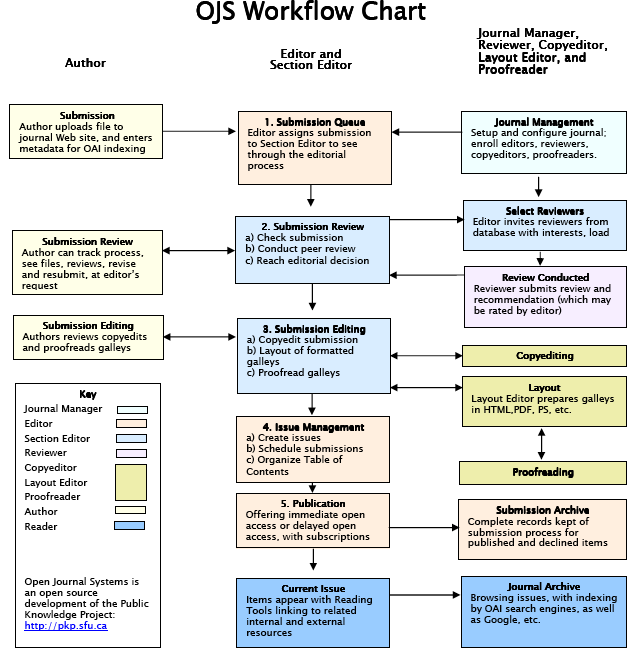
Editorial Workflow

The following workflow illustrates the general sequence of manuscript handling, from initial submission to final publication.

BARAKATI Journal manuscript submission, editorial screening, double-blind peer review, revision, editorial decision, and publication workflow